
That tight feeling after cleansing, flaky skin on the sides of your nose, a dull complexion: if you’re wondering how to effectively moisturise very dry facial skin for more than just a few hours, you’ve come to the right place. Anyone who experiences this problem knows that it’s not enough to just “slather something on” and hope it goes away. When your facial skin starts to lose water faster than it can retain it, the discomfort becomes constant: itching, redness, make-up that doesn’t go on smoothly and micro-cracks that get worse in the cold. The point is that drinking water, while essential for health, does not solve skin dryness on its own, because the skin barrier is like a door that decides how much to let in and out. If that door has micro-cracks, moisture escapes. In this practical guide, I will walk you through the most common causes, the most effective skin remedies and, above all, a concrete routine for treating dry skin on the face, with advice on key ingredients (fatty acids, sebum-like ceramides) and an example of use with a cream designed for the barrier, such as Oleage. We will talk about what really makes a difference in everyday life, how to choose the right cream and cleanser for your skin type, and how to prevent relapses. I will also tell you about little “professional” tricks that help keep your skin supple, soft and radiant over time. Ready to find out how to go from dull skin to hydrated skin in a sensible and lasting way?
The skin on your face is one of the most exposed parts of your body: wind, temperature changes, harsh cleansers, make-up, face masks. What’s more, the face is one of the first places we notice changes: when the skin on our face becomes rough, dull and reactive, our quality of life suffers. It’s not just a question of aesthetics: dry skin is a less efficient barrier, more vulnerable and more prone to micro-lesions and irritation. Here are the signs of dry skin that I often recognise in consultations:
– feeling of tight skin after cleansing or in the open air
– visible flaking on the cheeks and sides of the nose
– make-up that highlights flaky skin and fine lines
– patchy redness and occasional itching
When it comes to fragile skin, ‘less is more’: reducing friction, increasing lipid nourishment and protecting the barrier make all the difference. Have you ever wondered why, even when using your usual cream, the situation worsens at certain times?
Discover the main causes and then discover the causes of skin problems that we often overlook in our daily lives. One sentence sums up the heart of the problem: the causes of dry skin and seasonal worsening rarely depend on the water you drink, but on the barrier. There are many underlying conditions that cause dry skin, and the causes of dry skin can vary from person to person. What actually causes dry skin?
– Environmental changes: cold weather, wind and dry indoor air lead to skin dehydration.
– Excessive or unbalanced cleansing: strong surfactants that remove the skin’s natural oils.
– Complicated routines: too many exfoliating agents or retinoids without lipid compensation.
– Age, hormones, medications: these reduce the production of skin lipids.
– Stress and lack of sleep: these affect the skin’s ability to repair itself.
When the skin on your face begins to lose lipids and water, invisible micro-cracks form; the hydrolipidic film thins, the skin’s ability to retain what it needs decreases, and the skin becomes much more reactive to external stimuli. The result? As the days go by, the skin on your face becomes more fragile, reddened and prone to cracking. And here’s the key point: restoring the barrier, not just adding water, is what really treats the skin deep down.

Hydrating does not just mean “adding water”, but reducing trans-epidermal water loss (TEWL). Even with excellent systemic hydration, if the stratum corneum is damaged, water evaporates more quickly. It’s like filling a bucket with holes: until you repair the holes, it will continue to empty. This is where the skin barrier comes into play, made up of corneocytes and intercellular lipids (ceramides, cholesterol, fatty acids) organised like ‘bricks and mortar’. If the mortar is poor, evaporation accelerates.
When facial skin is under stress (cold weather, harsh cleansers, repeated exfoliation), it can become dehydrated even if you drink enough fluids; in these cases, the priority is to rebuild the lipid matrix. Dermatological data and guidelines (American Academy of Dermatology; European Academy of Dermatology and Venereology) suggest a two-step strategy: reduce the factors that increase TEWL and replenish lipids in a balanced ratio to restore cohesion and flexibility. When it comes to “what really works”, ask yourself: if after a week of only water and light serum you still feel your skin tightening, isn’t that a sign that you need the “right” lipids?
Another common misunderstanding concerns moisturising serums with a high percentage of glycerine or hyaluronic acid: useful, yes, but if they lack sealing lipids, they can attract water to the surface without preventing it from escaping. The result: a rebound effect of dryness in the following hours. To improve skin hydration in a stable way, you need a cream that repairs and seals, creating a protected moist environment in which natural repair processes can work.
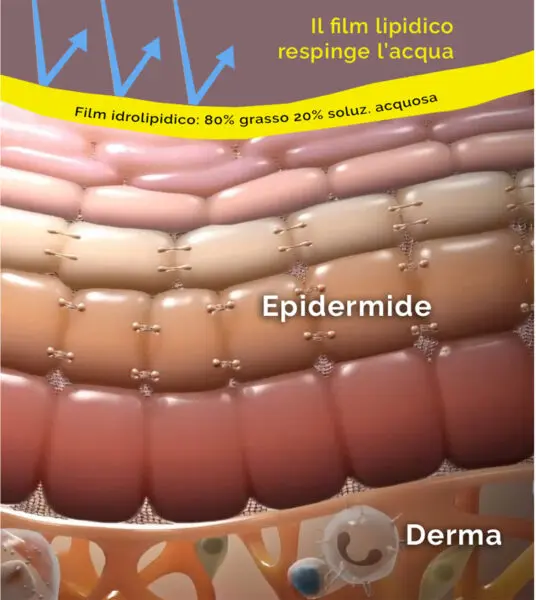
Imagine the stratum corneum as a mosaic: the cells are the tiles, the lipids are the mortar. When the “mortar” is missing, micro-cracks appear, allowing water to escape and irritants to enter. The skin barrier is therefore the first target of any repair-oriented skincare treatment: strengthening it means reducing TEWL and increasing comfort and resilience. The skin’s natural oils, together with ceramides and cholesterol, create orderly layers that keep moisture in the deeper layers of the skin and protect it from daily damage; if you remove them with aggressive cleansing or dilute them with too many actives, the skin can no longer defend itself properly.
When deciding what to use, remember that the face is more exposed than the body and often needs more refined textures: lightweight but rich in functional lipids. Reintroducing essential fatty acids (linoleic, alpha-linolenic) and ceramides helps rebuild the “mortar,” while cholesterol and triglycerides modulate flexibility and sealing. This is where the skin’s ability to retain water over time also comes into play: when you increase the right lipids, cellular cohesion improves and the microenvironment stays more hydrated and tolerant.
Additionally, improving daily habits (lukewarm water, patting towels dry, gentle cleansing) reduces mechanical stress and supports continuous repair. Have you ever noticed how prolonged hot showers make dryness worse? It’s the mosaic becoming disorganized: a more mindful routine is enough to reverse the trend.
In treating dry skin, smart formulas matter more than “trendy” ingredients. Dermatological research shows that balanced blends of ceramides, cholesterol, and fatty acids in ratios similar to those of the stratum corneum support repair. Sebum-like ceramides are especially interesting because they mimic the skin’s natural lipid composition: when included in a well-structured cream, they integrate into the barrier’s “mix” and make the skin more flexible and comfortable. Alongside them, essential fatty acids (such as linoleic acid) work on the intercellular cement and help treat the skin in depth, especially when dehydration is accompanied by redness.
And what about tolerability? Excellent: these are ingredients that sensitive skin usually accepts very well. Even those with oily but dehydrated skin can benefit by choosing lightweight, non-comedogenic textures; people with normal skin can introduce them during colder months. In short, everyone can use them by adjusting texture and frequency.
Want a practical tip? Choose formulas with:
balanced ceramides NP/AP/EOP, cholesterol, and free fatty acids
humectants (glycerin, hyaluronic acid) to bind water
antioxidants for daily protection
A small myth to debunk: natural remedies for the skin are not automatically better. Pure butters and oils can provide temporary relief but, on their own, they do not rebuild the skin’s orderly barrier structure. Choose combined products, tested on normal or dry skin, with a physiological pH and without strong fragrances. Are you surprised by how much your make-up performance can improve when the lipid base is just right?
Choosing the right cream and cleanser is crucial to hydrate the skin without causing irritation. Start from your skin type: every skin type needs an intact barrier, but your skin type determines texture and frequency of use. If your skin is very reactive, look for a gentle sulfate-free cleanser with amphoteric surfactants and replenishing lipids; keep the water temperature low and minimize contact time. After cleansing, apply a humectant serum and then a moisturizing cream with ceramides and fatty acids to “seal” everything in. To maximize effectiveness, apply your moisturizer while the skin is still slightly damp: it helps distribute the product and improves the penetration of actives into the intercellular spaces.
How to navigate formulas? If you prefer rich textures, choose creams with a higher oil phase or water-free options; if you’re worried about shine, opt for lightweight emulsions or gel-creams with finely dispersed lipids—what matters is that they are high-quality and/or organic. In both cases, check that the ingredients include ceramides and free fatty acids. This approach works well for your skin type because it combines hydration and sealing: humectants that bind water + lipids that rebuild the “mortar.” If you’re wondering whether adding only a serum is enough, ask yourself: why not give your barrier the “bricks” as well? Lastly, remember: hydrating dry skin isn’t a sprint—it’s a consistent routine that, day after day, restores balance and comfort.
Oleage offers waterless creams and serums designed to support the skin barrier with essential fatty acids and sebum-like ceramides in a balanced ratio. The goal? To hydrate and protect the skin by helping it rebuild the stratum corneum. Here’s a simple and general sequence to get the most out of Oleage products:
Morning: gentle cleansing; humectant serum; a thin layer of Oleage Cream.
Evening: cleansing; a generous amount of Oleage applied to areas that feel tight; optionally add light occlusion (a damp cotton cloth for 5–10 minutes) to increase comfort.
This approach helps nourish the skin and keep it hydrated in the following hours by reducing TEWL. To keep your facial skin hydrated consistently, focus on regularity rather than quantity: it’s better to use less product, but every day. If your dryness worsens in winter, increase the evening dose and apply a light massage until fully absorbed. Two studio tips:
If your skin is chapped, remove flakes without irritating by using a damp microfiber cloth with gentle movements: it helps eliminate peeling without breaking the barrier again.
Once a week, add a “lipid booster” mask: a thicker layer of Oleage left on for 20 minutes, then remove the excess.
Remember that dry facial skin requires patience and consistency: the face needs a calibrated approach, and often it needs targeted care after periods of intense cold or exfoliating treatments. If you’re asking yourself, “What can I change right now?”, reduce water temperature and friction, and prioritize creams with functional lipids. After two weeks of consistent use, many people report noticeably greater comfort and a smoother surface to the touch.
This dry skin routine works because it helps keep the skin in a protected, moist microenvironment that supports enzymatic renewal processes. In the medium term, a more cohesive barrier improves comfort and overall skin well-being. If your skin tends to be reactive, introduce the steps gradually (every other day) and monitor how it responds. This allows you to treat dry skin while respecting its pace and maintain skin health with fewer, but more targeted, products.
One last practical note: preventing dry skin is easier than “putting out the fire.” In autumn and winter, increase indoor humidity, limit prolonged hot water exposure, and apply Oleage immediately after cleansing. If you often find yourself thinking, “When my skin gets worse, I don’t know how to manage it,” simplify: reduce potentially irritating actives for a few weeks and focus your routine on ceramides and fatty acids. This way, you put back at the center what truly matters: a strong barrier that supports everything else.
What mistakes do I see most often? Too much exfoliation, frequent cleansing, very hot water, improper use of creams and serums, and too many steps in the daily skincare routine. Treat dry skin gently: pat instead of rub, choose soft fabrics, and prefer products without strong fragrance. If you want to speed up results, combine:
humectants to retain water, such as hyaluronic acid
sebum-like lipids to rebuild the “mortar” that forms the skin barrier
antioxidants to protect the skin barrier daily
When your facial skin is in balance, you’ll feel less sensitivity and more comfort, and your make-up will glide on more smoothly. And if you’re wondering, “Can dry skin improve with diet?”, the answer is that nutritional support helps, but it doesn’t replace topical work on lipids. Including sources of omega-3 and omega-6 in your diet is useful for overall well-being, but the surface “seal” remains essential. The expected result? A softer, more even, more elastic skin surface with fewer recurrences of redness.
Marta, 39, normal-to-dry skin in winter, works in an office with dry air. In November she reports that her face is a constant problem: patchy burning, foundation emphasizing flakes, especially on the cheeks and sides of the nose. Initial routine: double cleansing, acid serum every evening, lightly fragranced cream. Intervention: simplified routine, single gentle cleanser, humectant serum in the morning, Oleage morning and evening for two weeks, exfoliant suspended.
Result after the second week: reduced tightness, flaking almost gone, more even make-up. After the fourth week: smoother texture and stable comfort; Marta also adds H2Oleage’s gentle scrub once a week for refinement while keeping Oleage as her base. The lesson? Deeply hydrating facial skin requires rebuilding the lipid seal: without it, water keeps escaping and actives just “slip” over the surface.
– My skin type is confusing: where do I start? Start with the effective minimum: H2Oleage gentle mousse cleanser and Oleage cream. After two weeks, evaluate whether to introduce a humectant serum or a mild exfoliant. This progressive approach reduces irritation and improves consistency.
– Gommage or acids to remove flakes? Better a soft cloth and consistent lipid-rich hydration. If you add acids, choose low concentrations and reduced frequency, always supported by lipids to avoid reopening micro-cracks.
When the barrier is compromised, the goal is not to “flood the skin with water” but to reduce losses and restore the lipid mosaic. We’ve seen the main causes, how the hydrolipidic film becomes damaged, and why micro-cracks let water escape. We also clarified how fatty acids and sebum-like ceramides are key ingredients for repair, and how using a targeted cream like Oleage can make results faster and more stable.
In practice: simplify your routine, choose a gentle cleanser, and use a cream with physiological lipids like Oleage products. Just a few consistent choices can change your daily comfort and restore the skin’s natural balance. If you want a concrete first step, try the gentle cleansing + Oleage sequence twice a day for 14 days and note your sensations: you’ll notice less friction, more softness, and a more even complexion.
Want to explore how to hydrate very dry facial skin in a personalized way? Write to me at [email protected] with your current habits and context (climate, work, any actives): I’ll help you tailor an essential and sustainable routine that can truly transform your skin day by day.
Q1. How can I tell the difference between dry skin and dehydrated skin?
Dry skin lacks lipids; dehydrated skin lacks water. The first tends to feel rough all year round, while the second may look shiny but still feel tight. They often coexist: both need a strong barrier (lipids) plus humectants in the hydration routine.
Q2. Can I exfoliate if I have dry facial skin?
Yes, but with great caution and only rarely. Choose enzymes or mild acids at low frequency, always followed by creams with ceramides and fatty acids. If redness appears, stop and focus your routine on repair.
Q3. What is the best time to apply moisturizer?
Right after cleansing, when the skin is still slightly damp. This maximizes skin hydration and comfort. In winter, an extra layer in the evening on areas that feel tight can make a real difference.
Q4. Is Oleage also suitable under makeup?
Yes: let it absorb for 2–3 minutes and then apply your makeup. The smoother base reduces the “flaky” effect and makes the foundation more even. If your T-zone looks shinier, use less product there.
Q5. How long does it take to see results?
Relief is often immediate; for a more stable skin barrier, you need 2–4 weeks of consistency.

Come leggere l’INCI dei cosmetici: guida pratica per capire cosa utilizzi Capire come leggere INCI cosmetici significa imparare a guardare la formula con occhi più liberi. Non serve conoscere ogni nome a memoria: basta sapere come sono ordinati gli ingredienti,

Crema viso biologica fa bene? Cosa sapere prima di sceglierla Una crema viso biologica fa bene quando è formulata bene, certificata in modo chiaro e adatta al tuo tipo di pelle. Non è automaticamente migliore di ogni crema tradizionale o
Meglio crema idratante o nutriente? Qual è la differenza e cosa scegliere per la tua pelle Se ti stai chiedendo se è meglio una crema idratante o nutriente, probabilmente la tua pelle ti sta mandando segnali poco piacevoli: tira, si


Subscribe to our newsletter, enter your email:
Via F. Gregorovius 52, Perugia (PG)
VAT 03875550547
Subscribe to the newsletter to get a 15% discount on your next order