
If you are looking for the best face cream for dry skin, you probably know that tight feeling, skin that “drinks” the product but after an hour it feels like you’ve applied nothing and makes achieving hydrated skin a real challenge.
The truth is that a face cream for dry and sensitive skin should not just hydrate: it must rebuild the skin barrier, nourish it with compatible lipids, and retain water in the right layers.
This article comes from our hands-on experience with dry to very dry skin, often reactive as well, that deals with flaking, mild itching, and fine lines that appear more visible than usual.
Today we want to help you understand how to truly choose the right face cream for your dry skin: we’ll explain what distinguishes dry skin from sensitive skin, the mistakes we see most often, the ingredients that actually work (from compatible lipids to restructuring substances up to liposomal hyaluronic acid), and why many creams hydrate only on the surface.
We will look at two concrete examples, our Oleage Classic Ristrutturante and Biotech Idratante face moisturizers, as case studies that help guide your choice toward the product best suited to your skincare needs.
Our goal is to give you concrete tools to hydrate your skin, reduce dryness, and improve facial elasticity with a sensible, effective treatment that respects sensitive skin.
Ready to understand which face creams for dry skin are truly worth it?
La pelle secca del viso non è solo “pelle che non beve abbastanza acqua” o assorbe rapidamente l’idratazione esterna.
It is a condition in which the protective barrier is depleted of lipids and transepidermal water loss increases, leaving the skin dehydrated, dull, flaky, and with an uneven texture.
The result? Light reflects less effectively and fine lines appear more pronounced.
This situation mainly affects (but not only) those who live in cities. Environmental factors such as wind, temperature changes, air conditioning, and pollutants accelerate skin dehydration and can damage an already fragile barrier.
Certain dietary habits as well (few sources of essential fatty acids, poor hydration) and aggressive skincare routines (stripping cleansers, excessive exfoliation) also contribute to facial dryness.
To hydrate the skin with long-lasting results, it’s important to focus on what causes it to become dehydrated.
Have you ever felt your skin “tight” after a day in the office with dry air? Air conditioning and heating accelerate water loss, especially if the skin barrier is already damaged.
In winter, dry skin worsens because epidermal lipid production decreases; in summer, sweat and frequent washing with cleansers can further weaken the barrier.
UV rays also play a role: if you don’t use sun protection during the day (ideally a day cream with SPF, or even SPF 15 in less intense months), the hydrolipidic film is altered and elasticity decreases, forcing you to say goodbye to the soft skin you want.
When it comes to dietary habits, increase your intake of “good” fats (extra virgin olive oil, nuts, oily fish) and drink regularly: systemic hydration helps more than you might think.
In your routine, limit peeling to once a week and opt for a creamy cleanser or a gentle lotion that doesn’t strip the skin too much.
A small skincare coach tip: apply your hydrating serum and moisturizer to slightly damp skin to lock water into the stratum corneum. And on the toughest days, choose a rich moisturizing cream with a melting texture—you’ll feel your skin softer and more soothed from the very first application.
These are differences that change the choice of face cream, in fact dry skin and sensitive skin are not synonyms.
Dry skin lacks lipids and water; sensitive skin reacts easily with redness, tingling, and burning. You can also have dry and sensitive skin at the same time: in that case, you need a face cream that is both nourishing and soothing.
Very dry skin needs barrier-compatible lipids (ceramides, cholesterol, fatty acids) and powerful humectants (glycerin, hyaluronic acid).
Sensitive skin, on the other hand, requires fragrance-free formulas with few allergens and soothing ingredients such as panthenol, bisabolol, colloidal oatmeal, and niacinamide in well-tolerated concentrations.
You might ask yourself: how can I tell if my skin is more sensitive than dry? Listen to its signals and observe how it reacts after your skincare routine.
Here’s a simple test: after cleansing with lukewarm water, don’t apply anything for 10–15 minutes.
Does your skin feel tight and do flakes appear? You’re observing skin characterized by marked dryness.
Do you notice the appearance of red spots, burning, or itching?
Here there is a more significant sensitive component. Sensitive skin tends to “protest” against fragranced cosmetics, denatured alcohol, essential oils, and some exfoliating acids; for this reason, it’s helpful to look for fragrance-free creams, dermatologically tested on sensitive skin, and with clear tolerability claims.
In cases where redness persists or patches appear, it’s wise to consult a dermatologist: conditions such as seborrheic dermatitis or eczema can overlap and require dedicated treatment protocols.
In the meantime, the best thing you can do is choose a face cream for dry skin with an “intelligent” protective barrier: ceramides + cholesterol + fatty acids, combined with niacinamide at 2–4% and glycerin.
These combinations support lipid restoration, soothe the skin, and improve elasticity within a few weeks.
If the skin is very dry and sensitive, opt for a rich but non-occlusive texture: a well-balanced emulsion, a rich texture that absorbs with a short massage, without leaving a heavy “film.”
It may seem like a detail, but it makes the difference between feeling greasy and feeling protected.
One of the most common mistakes is choosing “highly fragranced” creams thinking they are more pleasant: they often contain allergens that irritate sensitive skin.
Another trap is choosing products that promise 24-hour hydration but contain mostly silicones and few functional lipids. The result? The effect is purely cosmetic, while the skin remains dehydrated underneath.
Another classic mistake is using an aggressive foaming cleanser: the skin feels “clean,” but then it feels tight, and the cream has to work twice as hard.
The daily routine is structured as follows: cleanser, serum, and day cream.
Let’s put it into practice.
Once a week, replace your cream with a nourishing mask for deep hydration.
Crucial question: do you need a face oil? It can help as a final step if the skin is very dry, but it doesn’t replace a moisturizing treatment because it doesn’t provide water.
And remember: fewer targeted products are better than many layered at random.
To treat dry facial skin, three pillars are needed: humectants, compatible lipids, and restructuring actives.
An extra that makes a difference: liposomal hyaluronic acid, which thanks to lipid carriers improves penetration and the persistence of hydration.
When it comes to texture, aim for a well-structured emulsion: the most modern face creams for dry skin combine different molecular weights of hyaluronic acid, glycerin at effective concentrations, and an “intelligent” lipid phase that doesn’t occlude.
Imagine the skin barrier as a wall: the cells are the bricks, the lipids are the mortar.
If the mortar is missing, the wall cracks and water escapes.
That’s why creams with ceramides, cholesterol, and free fatty acids work: they restore the missing mortar.
Formulas inspired by the skin’s natural composition reduce water loss and improve elasticity and comfort already in the first few days.
Have you ever noticed that some “rich creams” seem greasy but don’t actually soothe the skin?
They lack structured lipids or use only oils that are not skin-affine.
Look for “ceramides” in the INCI, together with squalane, cholesterol, shea butter, and medium-chain triglycerides. Niacinamide, at 2–5%, is the perfect ally: it reduces reactivity, stimulates the synthesis of endogenous ceramides, and improves the appearance of pores and skin tone.
Adding a rich moisturizing cream based on compatible lipids in the evening is often the turning point that resolves persistent dryness.
Practical note: a rich texture doesn’t mean heavy; the best “melting” emulsions absorb well and leave the face comfortable, not shiny.
Many creams rely on silicones and film-formers that optically smooth the skin, giving an immediate sensation of softness.
It’s a pleasant effect, but if effective humectants and structured lipids are missing, hydration fades and the skin remains dehydrated underneath.
Even hyaluronic acid, when used alone in a high molecular weight form, can act mainly on the surface.
And if the barrier is damaged, water continues to evaporate.
The result is the classic routine of “lots of product, little payoff.” How can you avoid this mistake? By reading the INCI and evaluating the texture: emulsions that are too light are not enough for very dry skin.
What should a cream for dry skin that actually works contain?
A combination of glycerin among the first ingredients, multi-weight hyaluronic acid (preferably liposomal), and a lipid-ceramide blend. If panthenol, allantoin, niacinamide, and antioxidants are also included, even better.
In some cases, collagen hydrolysates and wheat proteins can act as moisturizing film-forming agents, improving comfort and smoothness.
Texture says a lot: a melting texture “melts” into the skin and absorbs without leaving a film; a rich texture supports very dry skin during the night. Rhetorical question: how many times have you bought a “24h” cream and, after lunch, you were already looking again for a lip balm for your face?
Here is a practical criterion: apply the cream and evaluate after 4 hours. Is your skin still elastic and soft? Good, you are getting deep hydration. If not, try changing the structure: a moisturizing face cream in a 50 ml format with a well-built oily phase can be the turning point.
For daytime use, don’t forget protection: many dry skin types tolerate facial and body sunscreens with modern filters very well.
When choosing the best creams for dry skin, we like to give concrete examples to understand what to look for.
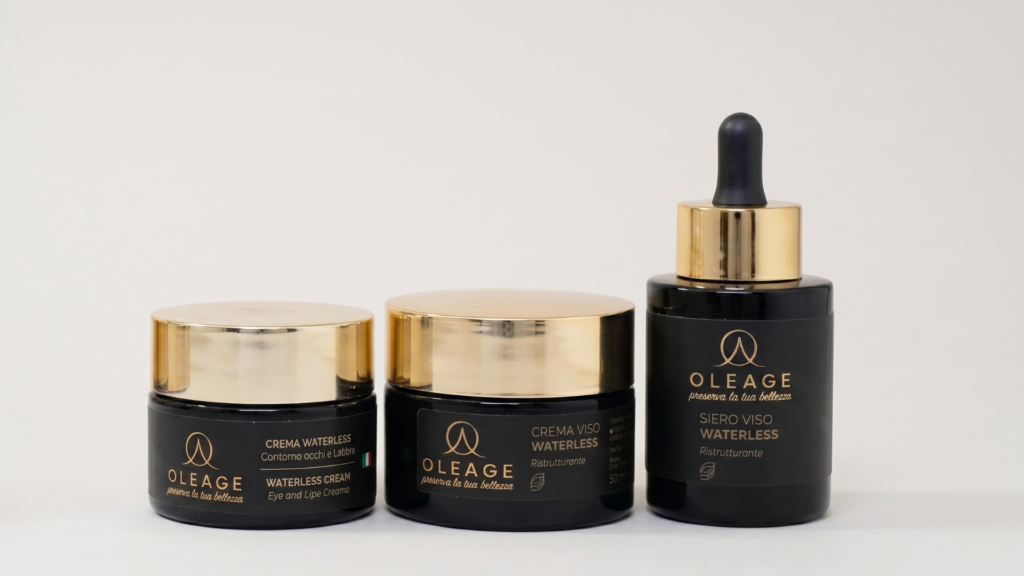
Oleage Classic Ristrutturante is a rich cream designed for dry and very dry skin: it combines ceramides, cholesterol, fatty acids, and shea butter, with high-concentration glycerin and soothing niacinamide.
The practical result is a nourishing and soothing effect that supports the protective barrier and reduces flaking. The texture is a creamy, comfortable emulsion, ideal as an evening moisturizing treatment.
Biotech Idratante, on the other hand, works on deep hydration: it uses liposomal hyaluronic acid for prolonged release, combined with pro-age peptides and antioxidants that enhance smoothness.
It’s designed for normal to dry skin looking for a lighter daytime finish but intense hydration.
Both formulas are dermatologically tested and designed for sensitive skin.
And what about anti-wrinkle action? The synergy between niacinamide, peptides, and structured hydration improves elasticity, with a slight optical lifting effect.
We’ve seen that choosing the best face cream for dry and sensitive skin requires a clear compass: deeply hydrate, nourish with compatible lipids, and repair the barrier.
You’ve learned to distinguish between dry and sensitive skin, avoid common mistakes, and read the INCI with a strategic eye: glycerin, hyaluronic acid (preferably liposomal), ceramides, cholesterol, fatty acids, and niacinamide are the winning team.
We’ve analyzed why some creams only hydrate on the surface and how to recognize true deep hydration, along with two concrete examples—Oleage Classic Ristrutturante and Biotech Idratante—useful as reference models.
The path is always the same: a simple, consistent routine built around your skin.
Come leggere l’INCI dei cosmetici: guida pratica per capire cosa utilizzi Capire come leggere INCI cosmetici significa imparare a guardare la formula con occhi più liberi. Non serve conoscere ogni nome a memoria: basta sapere come sono ordinati gli ingredienti,
Crema viso biologica fa bene? Cosa sapere prima di sceglierla Una crema viso biologica fa bene quando è formulata bene, certificata in modo chiaro e adatta al tuo tipo di pelle. Non è automaticamente migliore di ogni crema tradizionale o
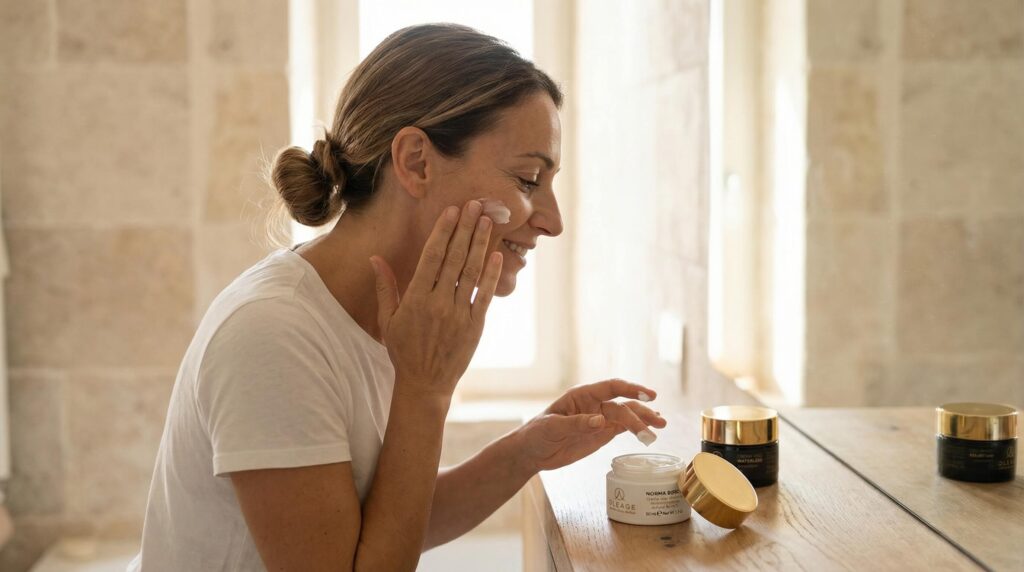
Meglio crema idratante o nutriente? Qual è la differenza e cosa scegliere per la tua pelle Se ti stai chiedendo se è meglio una crema idratante o nutriente, probabilmente la tua pelle ti sta mandando segnali poco piacevoli: tira, si


Subscribe to our newsletter, enter your email:
Via F. Gregorovius 52, Perugia (PG)
VAT 03875550547
Subscribe to the newsletter to get a 15% discount on your next order